×

Warning

JUser: :_load: Unable to load user with ID: 43

JUser: :_load: Unable to load user with ID: 40

Remote installation

The following procedure will show you how to set up the installation so that it can be remotely performed by our technical support.


Installation file

The most common way to install ISPadmin is using installation DVD which is available at promo events, or downloadable from download.ispadmin.eu. It is a ispadmin-XX-64bit-debian7-DVD.iso file (XX represents ISPadmin version).
ISPadmin runs on a Debian GNU/Linux distribution which is included in the installation DVD so there is no need to have a Linux installation ready prior to ISPadmin installation. Just burn the downloaded ISO file onto a DVD and follow the instructions.


Preparation

Switch to BIOS while booting up (by pressing Del / F2 or similar), and check that Advanced Host Controller Interface (AHCI) support is enabled for SATA hard drives. If your motherboard does not support AHCI, no problem. However, if there is such an option enable it. If you leave this option disabled the system will work with SATA drives in a mode compatible with older IDE drives, and I/O speed will be much lower than AHCI-enabled option.

Insert installation DVD into the drive and boot from it. There are 2 methods of booting from DVD.


Method 1 - Enable booting from DVD/CD in BIOS. The system will boot from DVD all the time. This might represent a problem while installing ISPadmin because you will need to boot from HDD after installation to finish configuration.
Method 2 - Press F11 or similar to get to boot menu. Select booting from DVD/CD. This way you will ensure that first booting will be done from DVD and then, after restart, from HDD as defined in BIOS. No help with server manipulation will be needed from your in this case.


When the system is launched, installation environment will be prepared and a welcome screen is displayed. Click OK to confirm and proceed to Remote install. If you cannot see this screen, press enter.
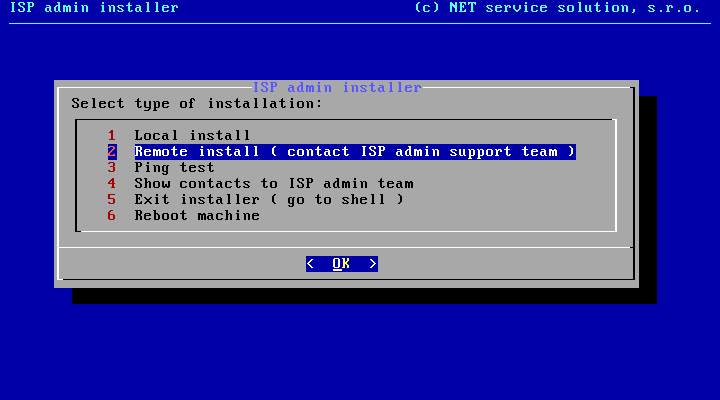
 

Installer

Internet connection settings - Remote install


1. Set up IP address so that the server is accessible from the Internet. That is, either you enter public IP, or the machine is in your network so you enter private IP address and ensure mapping of ports 22, 80 and 443 from public IP address to your private one on your main router.
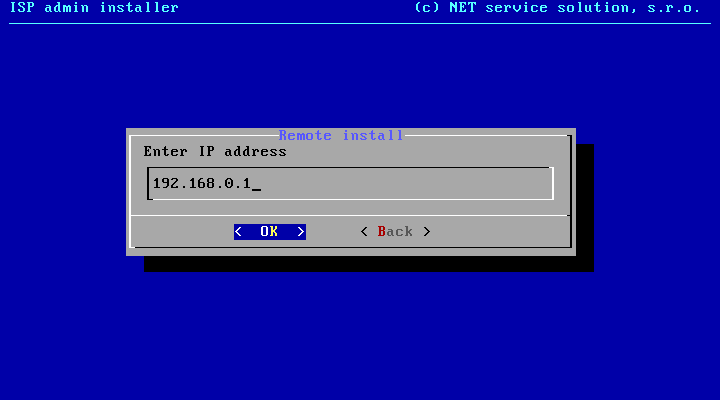
 

Remote install1


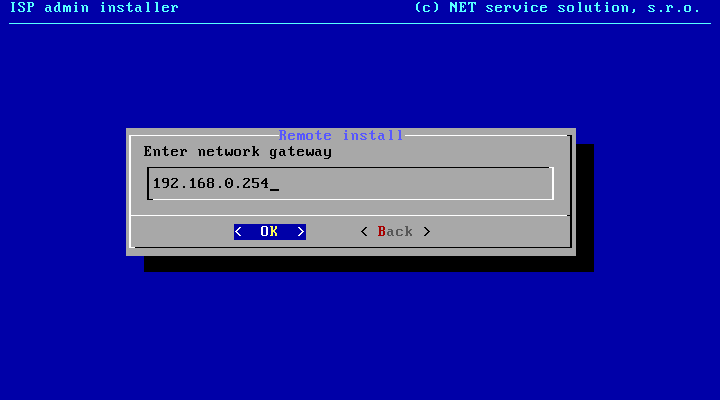
2. Enter network mask

Remote install2


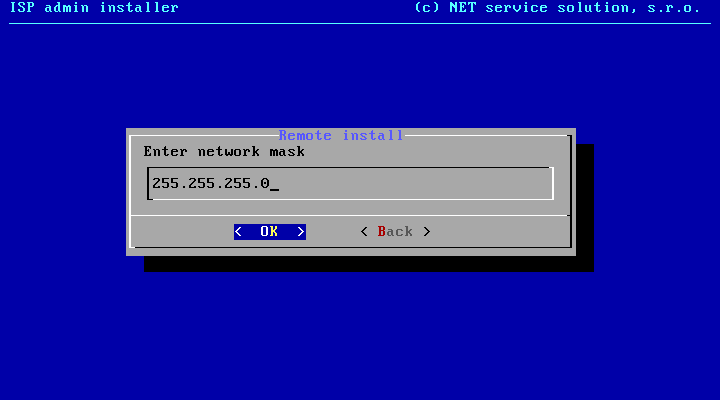
3. Enter network gateway

Remote install3

Completion of connection settings


You will see an overview of IP addresses that you have entered. Click Yes to activate them. Preparation is completed and you can contact your technical support.
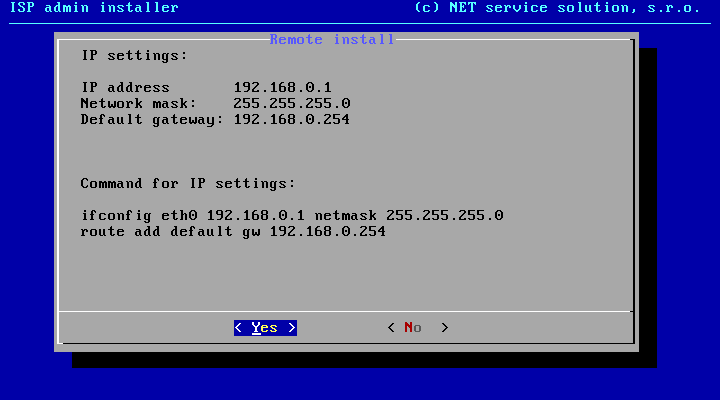
 

Remote install4

Contact us


And now just send us configured IP address to This email address is being protected from spambots. You need JavaScript enabled to view it. or call technical support. We will look after the rest.

The installation will have to be configured later on.

System back-ups

ISPadmin has an automatic data back-up functionality. It is possible to store...

MySQL database

Restart of MySQL service /etc/init.d/mysqld restart Recovery of database...

ISPadmin update

Switch to new system version using the following command from command line (logi...

Postfix mail server

By default, the SMTP server is configured in the way that it is only possible...

System Variables

System variables are used for replacing items such as client's name, address,...

System migration

The information contained in this manual pertains to the migration of ISPadmin ...

Emails cannot be sent because of their size

Check and modify the settings of the following parameters: upload_max_f...

Ramdisk and RRD backup-data restoration

More on RAM disk here (index.php?option=com_content view=article id=508:4-11-bet...

HTTPS Certificates

These are instructions on how to create and set up trustworthy certificates (h...

Crashed table repair

these instructions (index.php?option=com_content view=article id=1284:system-bac...

Moving graphs to RAMDISK

The main usage load for disks, on which the system is installed on, is the gener...

Forgotten root password

You can try two ways: First procedure 1. Insert installation DVD of ISPa...

Text editors

Nano text editor is always used in this documentation. If you don’t...

Linux update

For reasons of compatibility and availability of future versions of ISPadmin,...

ISPadmin serving as SMTP server

By default, the SMTP server is configured in the way that it is only possible to...

Cache-only DNS server

Caching-only is ready after installation of ISPadmin. It is sufficient to use IP...

Technical support status cannot be verified

If technical support cannot be verified, most likely it is due to DNS malfunc...

Administration of running processes

We recommend using htop program for easier monitoring of running process inst...

Timezone settings

"Europe/Prague” timezone is set by default. To change it, do the following:...

IPv6

ISPadmin does not currently support IPv6, it only supports IPv4. It is, of cours...

Configuration / update of IP Address

A) Temporary setting of IP address (until next Linux restart).Just add the fo...

High CPU load of ISPadmin server

Run htop command from the Linux console to determine the problems. With this ...

ISPadmin operation behind NAT

If you have your ISPadmin located on private network and wish to access it from ...

Manual update

If the Error 404: Not Found message appears during an update, it will be necessa...

Inner/outer address on ISPadmin server

The system is typically connected to the network by one network card only. Both ...

Running service check

If you need to find out if a certain process is running use the following comman...

Error "Allowed memory size of ... bytes exhausted ..."

Fatal error: Allowed memory size of ... bytes exhausted (tried to allocate ... b...

What is the directory structure in /usr/local/script/ispadmin/rrd_data?

headend ipaccount modem routers snmp switches user_devices wifi

«
»

CONTACT

NET service solution, s.r.o.
Žerotínova 3056/81a
787 01 Šumperk
Czech Republic